



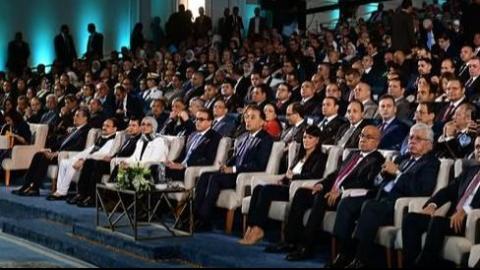
His Excellency, the Secretary-General of the Higher Council for Population, Professor Dr. Issa Almasarweh, and the Director of Studies and Policies, Ali Al-Mutlaq, participated in the events of the International Conference on Population, Health, and Human Development in its third edition. The conference was organized by the Ministry of Health and Population in the Arab Republic of Egypt during in November 2025, under the slogan "Empowering Individuals, Promoting Progress, Providing Opportunities", and under the patronage of Egyptian President Abdel Fattah El-Sisi. The conference was inaugurated by Dr. Mostafa Madbouly, the Prime Minister of Egypt, who emphasized in his speech that the health agenda is a top priority in human development by utilizing all resources to maximize benefit and integration among various entities. The conference witnessed broad participation from international and regional organizations and experts in the fields of sustainable development.
The conference aimed to promote sustainable human development by investing in lifelong learning and digital skills, ensuring equal access to education and employment for all, and enhancing health and social equity through expanding universal health coverage and integrating social determinants of health into public policies—with a priority on protecting the most vulnerable groups. Additionally, it sought to empower all generations by supporting effective participation in society, promoting healthy and productive aging, and providing full opportunities to harness their potential in development pathways. It also aimed to strengthen identity and social cohesion by leveraging culture and sports as effective means to build community belonging, enhance resilience and civic engagement, and address global challenges related to migration, environmental change, and population vulnerability through adopting innovative, knowledge-based solutions aligned with current global transformations.
The conference featured multiple themes reflecting a comprehensive vision for human development that places people at the core of public policy. These themes included strengthening the interconnection between health, education, housing, and the economy through equitable policies ensuring universal health coverage and affordable, quality services; advancing the care economy and inclusive development by highlighting the socioeconomic value of care work and supporting women's participation and empowerment as a cornerstone of sustainable growth; and promoting social protection and economic justice by enhancing social safety nets to reduce poverty and narrow societal divides.
Another theme focused on education and lifelong learning, aiming to build generations capable of adapting to current and future transformations through flexible and inclusive education. The conference also emphasized investing in youth by equipping them with the necessary skills and opportunities for the future and empowering them as active partners in development and digital transformation, alongside a theme dedicated to culture, sports, and national identity. Additionally, it addressed population dynamics by turning demographic challenges—such as youth bulges, aging, urbanization, and migration—into opportunities for inclusive growth; healthy aging and longevity by expanding care and support for the elderly and enhancing their participation in community and economic life; and migration, environment, and population vulnerability by addressing the repercussions of climate change, displacement, and migration through innovative solutions that build resilience. Finally, a theme on digital innovation highlighted the transformation in health, education, and social services through technology.
The conference concluded by issuing several recommendations distributed across three main themes. Under the first theme, Population and Development, the recommendations included: integrating a developmental vision into the population file through a comprehensive perspective encompassing economic and social empowerment, via a unified population plan and a "life course" approach; addressing unmet needs for contraception and unplanned pregnancy by providing long-acting family planning methods and adopting a "no missed opportunities" principle; economically and socially empowering women by increasing their participation in the labor market through legislation; and digitizing population data and converting "red" areas to "green" through a unified digital platform and artificial intelligence.
The recommendations of the second theme, related to health services, focused on investing in primary healthcare by transforming health units into integrated centers and implementing the "One Health" and "Life Course" approaches. They also aimed to reduce unjustified caesarean sections and maternal/neonatal mortality through a natural birth strategy, governance of the private sector, and establishing mother-and-child-friendly centers of excellence. Furthermore, they emphasized sustaining non-communicable disease screening, nutrition campaigns, and anti-smoking initiatives, while utilizing artificial intelligence for service distribution in remote areas and linking databases. Sustainable health financing was to be achieved through public-private partnerships, comprehensive insurance, and taxes on tobacco/harmful products. This was to be accompanied by accreditation standards, a multilingual call center, and the issuance of a digital health regulation law.
The recommendations of the third theme, pertaining to human development, focused on enhancing lifelong education and training by expanding technical education through the establishment of institutes; integrating artificial intelligence skills; empowering youth and women through leadership programs, entrepreneurship initiatives, correcting gender roles, and involving youth in policymaking; establishing comprehensive social protection that includes informal workers, linked to health/education insurance, and supporting the transition to formal work sectors; and strengthening multilateral cooperation through (regional/international) platforms for exchanging expertise in artificial intelligence, "One Health," and social protection.