


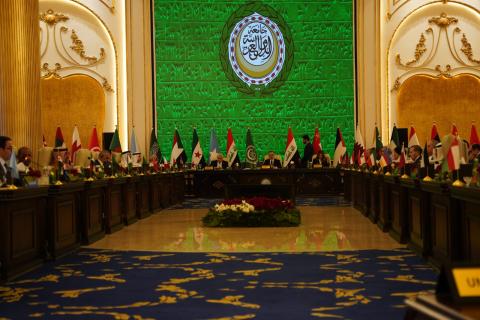
The Higher Population Council (HPC) represented by the Assistant Secretary-General for Planning and Monitoring, Rania Al-Abbadi, and the Principal Researcher, Ghaleb Al-Azza, participated in the seventh regular session of the Arab Council for Population and Development. This meeting was held in the Republic of Iraq and was organized by the Iraqi Ministry of Planning in cooperation with the League of Arab States - the Technical Secretariat of the Arab Council for Population and Development.
The meeting, attended by ministers, deputy ministers, secretaries of national population councils, senior officials from Arab countries, and representatives of regional and international organizations operating in the Republic of Iraq, and aimed to enhance Arab cooperation and exchange expertise and knowledge among Arab states regarding linking population policies to the 2030 Sustainable Development Goals and integrating demographic, economic, social, and environmental dimensions into development plans. At the conclusion of the meeting, recommendations and future directions were approved, along with practical decisions to improve population policies. These outcomes are to be submitted to the Economic and Social Council of the League of Arab States within the framework of joint Arab action mechanisms.
During her delivery of Jordan's address, the Assistant Secretary-General of the Higher Council for Population for Planning and Follow-up, Rania Al-Abbadi, emphasized that this meeting is taking place against a backdrop of a rapidly changing Arab demographic reality, accompanied by regional challenges that have contributed to adverse outcomes for the Arab demographic situation and the Arab region's progress towards comprehensive development. This necessitates conscious collective action. She highlighted that the population of the Arab world has surpassed half a billion people, with projections indicating it will reach 591 million by 2035. This presents simultaneous challenges and opportunities, particularly in the areas of services, resources, the labor market, and education.
Al-Abbadi explained that Jordan, guided by His Majesty King Abdullah II bin Al-Hussein, continues to implement comprehensive reforms. These include enhancing the alignment between educational outputs and labor market needs; strengthening primary healthcare, particularly for mothers and children, and responding to family needs for pregnancy and birth spacing; influencing the geographical distribution of the population; expanding social safety nets; and empowering women and youth, in line with the Economic Modernization Vision 2033, which places investing in human capital as a fundamental driver of sustainable development. Jordan is working to transform demographic challenges into opportunities by linking population policies to the national economy, enhancing reproductive health and family planning programs, and modernizing data and vital records systems, to ensure evidence-based decision-making that serves citizens and supports development plans. Jordan also continues its efforts to provide educational and health services for refugees and host communities, reflecting its humanitarian commitment and embodying its regional role in promoting stability and development.
The meeting discussed several topics and concluded with a set of important, pan-Arab supporting decisions. Key outcomes included enhancing the right to family planning as a lever for sustainable development in Arab countries; adopting the 2026 Arab Population and Development Day theme, "The Role of Youth and Promoting a Culture of Peace in Supporting Development"; boosting the readiness of the Arab region's population for artificial intelligence-driven economies; approving the charter for the Arab Region Population Excellence Award; strengthening and coordinating Arab stances for participation in the 59th session of the UN Commission on Population and Development in New York in 2026, focusing on "Population, Technology, and Research in the Context of Sustainable Development"; promoting population policies that support the silver economy; and advancing sexual and reproductive health in the context of mixed migration through the Women, Peace, and Security Agenda in the Mediterranean and Arab regions.