


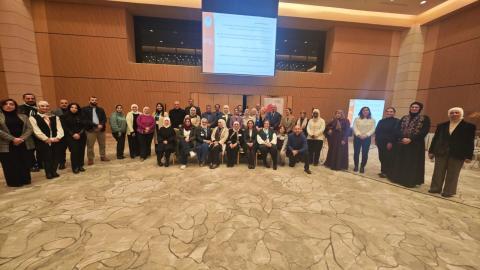
The Gender and Adolescence: Global Evidence (GAGE) program organized a dialogue meeting to present the findings of a study on young people’s knowledge of sexual and reproductive health and their access to and use of related services in Jordan. The event was held in collaboration with the Higher Population Council (HPC) and Share-Net Jordan, with the participation of representatives from relevant government institutions, non-governmental and international organizations, as well as civil society and academic actors. During the meeting, the results of the longitudinal research on young people’s needs and knowledge related to sexual and reproductive health and services were launched.
The meeting aimed to present the findings of the final mixed-methods research and to highlight the challenges faced by young people across all groups, including refugees and people with disabilities, as well as ways to address the underlying determinants affecting their access to knowledge and youth-friendly health services. It also sought to identify evidence-based priorities for decision-makers and policy and program developers by formulating joint policy and program recommendations to enhance access to appropriate sexual and reproductive health education and services for adolescents and young people from all groups, including the most vulnerable communities, and to integrate these priorities into the annual implementation plans of the National Sexual and Reproductive Health Strategy (2020–2030).
Gender and Adolescence: Global Evidence (GAGE) program is a decade-long longitudinal research program, supported by the UK Foreign, Common-Wealth and Development Office (FCDO). The program was implemented with a large and diverse sample of adolescents and young people from different communities across the governorates of Amman, Irbid, Jerash, Mafraq, and Zarqa. The sample included adolescent girls and boys from remote and underserved Jordanian communities, as well as refugee communities, out-of-school youth, those who were married before the age of eighteen, and persons with disabilities.
In his opening remarks at the meeting, the Secretary General of HPC, Professor Issa Almasarweh, highlighted that HPC is committed to utilizing knowledge and evidence derived from research findings and data in its work with partners to create an enabling policy and program environment that supports and strengthens protection mechanisms for adolescent girls and boys, and reduces the health risks faced by adolescents and young people. This, he noted, contributes to improving population characteristics. He further explained that achieving this requires comprehensive health education to become an integral part of school curricula and extracurricular activities, delivered by well-trained and well-supported teachers, as educators remain a trusted source of knowledge and skills across all education systems and are highly valued within Jordanian families and society.
Almasarweh further noted that comprehensive health education on sexual and reproductive health during puberty, adolescence, and youth provides young people with scientifically accurate health information that is appropriate to their age group and aligned with Jordan’s religious and cultural context. He also emphasized the importance of strengthening the role of parents and families in this area by empowering parents with correct guidance related to the health of their adolescent sons and daughters and by promoting dialogue between parents and their children. He added that the research findings presented during the event will contribute to gaining the support of policymakers and program developers to accelerate progress toward achieving Sustainable Development Goal (SDG) targets 3.7 and 5.3, which aim to ensure universal access to sexual and reproductive health care services and to eliminate all harmful practices, such as early and forced marriage.
For her part, Dr. Nicola Jones, Director of the Gender and Adolescence: Global Evidence (GAGE) program and Principal Research Fellow at the Overseas Development Institute (ODI) in the United Kingdom, emphasized the urgent need for complementary community-based programs to build life skills, focus on transforming gender-related social norms, and address adolescents’ needs for information related to their sexual and reproductive health. She also stressed the importance of implementing tailored awareness-raising activities for young people with disabilities to ensure that mobility challenges, societal barriers, stigma, and discrimination do not prevent them from enjoying their rights to health and protection.